

Longhorn Investment Team Weekly Insight: Final Four Edition (4/6/19)

What’s up gang! We know March Madness is coming to an end, and we had each of our members create an algorithm to predict the correct outcome of the NCAA tournament. It didn’t work. Anyway, lets dive into the news.

Trade War is Down to the Wire

Trade cannot play its full role in driving growth when we see such high levels of uncertainty.


Roberto Azevêdo, WTO Director General

In the World Trade Organization’s press release last week:

  • Global GDP growth expected to slow from 2.9% in 2018 to 2.6% in 2019 and 2020
  • Estimate of 2018 trade growth is lowered to 3.0% from early September estimate of 3.9% (WTO’s lowest forecast in 3 years)

““The U.S. has a point when it comes to IP theft concerns” – China


Larry Kurdlow, White House Economic Advisor

A possible concession from China in the realm of IP theft – a key point of contention in the current trade dispute – was all investors needed to hear. The S&P posted its second straight week of gains.

Is this information really actionable? Not really, while its good for the two countries to have an open dialogue, many questions such as the Huawei investigations remain unanswered. Moreover, actions speak louder than words, and Kurdlow’s statement came the day after a Chinese official was charged for trying to bring a thumb-drive loaded with malware onto Trump’s Mar-a-Logo resort.

March Job Report Comes in Clutch

The US added 196,000 jobs in March. Wages increased 3.2% year-over-year.

People expected 170,000 new jobs and 3.4% yoy wage growth.

Compare the March data to February (only 33,000 new jobs) and things are looking up as investors can still cling to employment data as a sign of a healthy US economy despite lower consumer confidence, retail data, and that yield curve situation…

Oh yeah, the yield curve! Remember how if long-term bonds have higher yields than short term bonds, investors pee themselves? Well that ominous cloud has subsided to a degree, as the yield curve returned to a relatively flat, but positive slope.

The Middle Market Has More Bandwagoners Than Duke Did

“Investment bankers across Wall Street are tripping over themselves, and sometimes each other, to win business advising smaller companies on deals – assignments they would’ve scoffed at two years ago” – The Wall

What do investment banks do?

A lot of stuff, but it’s common for them to facilitate mergers and acquisitions, or the buying and selling of businesses. For the purpose of simplicity, let’s assume all investment banks are primarily focused on M&A to make money (usually through a % fee based on the size of the transaction).

Big banks are shifting from fewer big marlin deals to lots of small tuna deals.

Yes, M&A in the fisheries market is booming. Just kidding, that was really an analogy. Let me explain. After 2008, there was a big recession so lots of companies consolidated, causing a boom in big time deals. Follow the recession with a decade of low interest rates and then a tax cut, and you see another wave of big time deals (CVS+Aetna, Disney+Fox, Amazon+Wholefoods).

What changed?

  • M&A activity for transactions over $2 billion has slowed down recently as tax cut savings have worn off.
  • Banks are turning to the middle market (companies that make between around $10 million to $500 million a year in revenue) for more and more business. M&A are extremely common among middle market companies, which presents the perfect opportunity for big banks that already lend to these businesses to cross-sell their M&A advice to middle market clients.

Why is that?

  • Middle market companies are frequently purchased by private equity shops. Private equity firms are companies that just buy other companies and flip them; it’s not complicated or anything. Right?
  • Middle market companies are commonly family-owned. Sometimes founders can’t get their kids to act as successors to the business, and acquiring talented employees is generally difficult as a family-owned business. This creates situations where owners are more likely to just sell their business.
  • Smaller companies are way more likely to create truly disruptive innovations. Big companies are bad at innovating, but they have the money to just buy the innovators when they’re small.

Anyway, big mergers are like the marlins and middle market deals are the tuna…

…and its tuna season, baby!

Why it matters for banks: Big investment banks like Goldman Sachs and JP Morgan are moving into a space crowded with regional banks that already specialize in the middle market. With middle market companies accounting for roughly a quarter of total revenue generated in the US, it’s no wonder banks are turning more and more to mid-size clients.

Why it matters for the middle market: A TD Bank survey found that 68% of middle market banks expect to undergo M&A in the next 2 years. The National Center for The Middle Market furthers 60% of middle market businesses are relying on inorganic growth as part of their strategy.

Because M&A can make or break a company, it’s crucial that they receive top notch advice from getting the right price on the deal to ensuring that the companies integrate properly to create synergies.

Other News:

Upcoming IPOs we forgot to mention last week: SpaceX, WeWork, Palantir, and iHeartMedia. iHeartMedia just announced their IPO which they are using to exit the bankruptcy they filed for last year. iHeartMedia’s bread and butter is podcasts. They claim to have 275 million US listeners per month on their platform. For context, Spotify claims to have 207 million global monthly users.

Lyft stock shorts were the most expensive bearish bet in the US stock market on Wednesday. In other words, investors clearly think it’s overvalued, driving up the price of put options contracts. It gets juicy – Lyft just accused one of their underwriters, Morgan Stanley, of marketing investment vehicles to short their shares. This could be a violation of lock-up agreements, contracts that prevent early investors from selling shares immediately after the IPO.

Verizon introduced 5G networks in parts of Chicago and Minneapolis, making them the world’s first commercial 5G provider. 5G will enable download speeds 10x faster than LTE. South Korea will be unveiling their 5G networks shortly, and you may have it in the top right of your screen as early as 2020.
Longhorn Investment Team Weekly Insight: Roundup Edition (3/31/19)

3 minute read

Welcome back to Longhorn Investment Team’s Weekly Insight, a place for you to catch up on key market news and trends. Nursing yourself back to health after Roundup? Well when your friends start trading party stories, it’ll be the perfect time to impress everyone with your “intellectual horsepower.” Keep reading to discover some finance-related party tricks.

Lyft goes Public

Overvalued? Maybe.

“We have a history of net losses, and we may not be able to achieve or maintain profitability in the future” – Lyft investor prospectus

Despite gaining market share over the past few years (up to 39% from 22% in 2016), Lyft reported a net loss of $911 million last year because investors keep subsidizing their “grow first, profit later” strategy. High investor demand despite no current earnings may sound reminiscent of the dot com bubble. At the time of its IPO, Lyft received a $24 billion valuation (props to JPM for advising). Let us know if you think this valuation is baloney or not.

The Big Picture: Lyft marks the debut of the widely anticipated tech IPO class of 2019. While most of the hottest tech companies were content as “unicorns” (unicorn = private startup worth over a billion dollars) for years, the wait for common investors is finally over. Other IPOs on deck include Slack, Pinterest, Airbnb, Postmates, and Uber. We’ll be giving more analysis on the new wave of IPOs over the next few weeks.

An Update on Space Warfare

On Wednesday, India PM Narendra Modi announced the country’s first successful test of their anti-satellite (ASAT) missile test. In other words, they blew one of their own satellites up with a ground-based rocket. What does this mean?

  1. Space is getting hot. India is just the latest country to jump in the global space race, which is currently dominated by China, Russia, and the US. Satellites are the name of the game in space warfare, as successfully jamming or destroying another country’s key satellites can send their military back to the stone age, which can be pretty scary. Space Force jokes aside, V.S. Vereshchetin, Director of the International Institute for Space Law wrote in 2010, “[U]p to now outer space has remained free from weapons as such. The situation would radically change should the plans for space-based weapons go ahead and trigger a new spiral in the arms race both in outer space and on earth […] which is not formally and specifically prohibited by any treaty in force.”
  2. Space is getting dirty. Ignoring the warfare aspect, ASAT weapons themselves – even their tests – create massive amounts of space debris. India’s test created 250 pieces alone, and China’s notorious 2007 ASAT test single-handedly increased the likelihood of a satellite collision by 37%. The takeaway: keep space clean so our satellites don’t crash and create more space debris. Also stop shooting satellites with rockets.

Blackberry (BB) Shares Soar on Q4 Earnings Beat

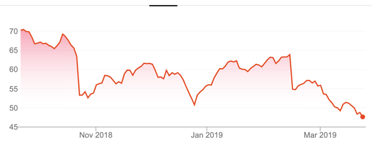
Not saying we called it, but four of our members pitched a long position on Blackberry two weeks ago. Check it out below to get a glimpse of their new business model.

Other News:

The US government is trying to force the sale of gay dating app, Grindr, from a Chinese corporation, Kunlun Tech Co., based on concerns that Chinese officials can use app data to blackmail US officials or contractors. There is no public evidence of privacy abuses or extortion actually occurring.

Krispy Kreme, Keurig, Dr. Pepper, and Panera Bread used to be run by Nazi’s who used forced POW slave labor during World War Two. That’s a bad look for the Reimann family, the owners of JAB holdings who recently pledged to donate $11 million to an undisclosed charity following their exposure.

LIT Weekly Insight:Spring Break Edition

3/25/19
3 minute read

Welcome to Longhorn Investment Team’s Weekly Insight, a place for you to catch up key market news and trends. For this edition, we’ll dive into some of the business news that everyone missed out on during their spring break mission trips.

S&P 500: 2800.71 (-.77%)
DOW: 25502.32 (-1.34%)
NASDAQ: 7642.67 (-.60%)

market performance from 3/18 to 3/22

ThE YiELD CuRvE InVeRtED

The market’s spring break rager came to a crash on Friday when the bond market showed some uncanny signs of recession (oh no!). That’s right, the 3month/10y year US Treasury yield curve went flat early Friday. Every time this has happened in modern history, a recession followed within the next two years.

So, what’s a yield curve?

A yield curve shows the difference in bond yields as time increases. Typically, a longer-term (10 year) bond has a higher yield than a short-term (3 month) bond. Why? Because bonds become more prone to fluctuations in interest rates the longer they are held, so higher yields compensate for that risk.

However, long term bonds yields have been pushed lower due to higher demand from investors, which pushed up the price of these long-term bonds.

Because bond yields and prices move inversely, the difference between short-term bonds and long-term bonds essentially vanished.

Why is this bad?

Well, why are more investors wanting to buy long-term bonds all of a sudden? People are losing faith in the global economy and assets tied to economic growth (ie. stocks) and shifting their money to safer investments: long-term treasury bonds.

Not all hope is lost. Some believe that the low bond yields are simply tied to the FED’s decision to keep interest rates low for the foreseeable future, which could indicate slow and steady growth over the next few years.

Our conclusion: things don’t look good.

One could argue that the FED is accounting for weaker economic growth by keeping rates low, but the federal budget certainty does not, as it assumes 3.1% GDP growth. An unproductive spending boom is typical cause of recessions in the inflationary boom-bust cycle, and we seem to have a recipe for just that.

Google’s Virtual Game Console

Meet Stadia, Google’s cloud-based gaming service that will stream games directly onto your laptop, phone, or TV. While Nvidia, Sony, Microsoft, and even Amazon are pushing similar products, Google is trying to differentiate Stadia in three key ways:

  1. Leveraging existing products and technologies: Google has both the back-end servers to facilitate cloud-based services and the user-facing platforms to deliver content. The vision is for you to be able to see a game clip on YouTube, click the “Play Now” button, and be stomping noobs in a matter of seconds.
  2. Teraflops on teraflops: AMD is providing a custom GPU (graphics processing unit) with 10.7 teraflops of power (teraflop = floating operations per second). That’s roughly twice the processing power of a PS4 or Xbox One.
  3. Catering to developers: Google is investing in features such as machine-learning tech that allows developers to apply their easily apply their own graphics styles. Google is also creating its own studio for exclusive Stadia content.

Why is Google doing this? The video game market is valued at $180 Billion.

Other News:

Netflix is rolling out a $3.25 per month, mobile-only streaming plan for customers in India. It’s no surprise that companies are targeting India’s less mature smartphone market, and it’s not uncommon for these firms to compete on price here. However, mobile Netflix plans can only grow as fast as the handset market, which faces its own challenges. A lack of affordability, education, and gender equality are all impediments to further smartphone diffusion in India.

Fun Fact:

Six Flags (SIX) charts look like the Texas Giant.